---
title: "qwen3-next-80b-a3b-instruct"
publisher: "qwen"
type: "endpoint"
updated: "2025-09-22T16:10:55.403Z"
description: "Qwen3-Next Instruct blends hybrid attention, sparse MoE, and stability boosts for ultra-long context AI."
canonical: "https://build.nvidia.com/qwen/qwen3-next-80b-a3b-instruct"
---
# **Qwen3-Next-80B-A3B-Instruct**
## **Description**
Qwen3-Next-80B-A3B-Instruct is a causal language model that is instruction-optimized for chat and agent applications. It features a Mixture-of-Experts (MoE) architecture that achieves an extremely low activation ratio, drastically reducing FLOPs per token while preserving model capacity. The model supports ultra-long contexts and has a Multi-Token Prediction (MTP) mechanism to boost performance and accelerate inference.
*This model is ready for commercial/non-commercial use.*
## **Third-Party Community Consideration:**
This model is not owned or developed by NVIDIA. This model has been developed and built to a third-party's requirements for this application and use case; see link to Non-NVIDIA model card here: [Qwen3-Next-80B-A3B-Instruct](https://huggingface.co/Qwen/Qwen3-Next-80B-A3B-Instruct).
## **License and Terms of Use:**
**GOVERNING TERMS:** The trial service is governed by the [NVIDIA API Trial Terms of Service](https://assets.ngc.nvidia.com/products/api-catalog/legal/NVIDIA%20API%20Trial%20Terms%20of%20Service.pdf). Use of this model is governed by the [NVIDIA Open Model License Agreement](https://www.nvidia.com/en-us/agreements/enterprise-software/nvidia-open-model-license/). ADDITIONAL INFORMATION: [Apache 2.0 License](https://huggingface.co/Qwen/Qwen3-Next-80B-A3B-Instruct/blob/main/LICENSE).
## **Deployment Geography:**
**Global**
## **Use Case:**
This model is well-suited for task automation, business applications, and agentic use cases. It excels in tool calling capabilities and highly complex reasoning tasks.
## **Release Date:**
Build.NVIDIA.com 09/18/2025 via [Qwen3-Next-80B-A3B-Instruct](https://build.nvidia.com/qwen/qwen3-next-80b-a3b-instruct)
Huggingface 09/11/2025 via [Qwen3-Next-80B-A3B-Instruct](https://huggingface.co/Qwen/Qwen3-Next-80B-A3B-Instruct)
## **Reference(s):**
**References:**
* [Qwen3-Next Blog Post](https://qwen.ai/blog)
* [Efficient Streaming Language Models with Attention Sinks](https://build.nvidia.com/qwen/qwen3-next-80b-a3b-thinking/modelcard)
* [Massive Activations in Large Language Models](https://build.nvidia.com/qwen/qwen3-next-80b-a3b-thinking/modelcard)
## **Model Architecture:**
**Architecture Type:** Hybrid Transformer-Mamba
**Network Architecture:** Qwen3-Next
**Total Parameters:** 80B
**Active Parameters:** 3.9B
**Vocabulary Size:** 151,936
### **Input:**
**Input Types:** Text
**Input Formats:** String
**Input Parameters:** One Dimensional (1D)
**Other Input Properties:** Natively supports context lengths of up to 262,144 tokens, extensible to 1 million tokens with YaRN scaling.
**Input Context Length (ISL):** 262,144
> **Qwen3-Next-80B-A3B-Instruct** supports only instruct (non-thinking) mode and does not generate ```` blocks in its output.
### **Output:**
**Output Types:** Text
**Output Format:** String
**Output Parameters:** One Dimensional (1D)
**Other Output Properties:** The model can generate up to 262,144 tokens and recommends an output length of 16,384 tokens for most queries.
**Output Context Length (OSL):** 16,384
Our AI models are designed and/or optimized to run on NVIDIA GPU-accelerated systems. By leveraging NVIDIA's hardware (e.g. GPU cores) and software frameworks (e.g., CUDA libraries), the model achieves faster training and inference times compared to CPU-only solutions.
## **Software Integration:**
**Runtime Engines:** SGLang, vLLM
**Supported Hardware:**
* **NVIDIA Ampere:** A100
* **NVIDIA Blackwell:** B200, B100
* **NVIDIA Hopper:** H100, H200
**Operating Systems:** Linux
## **Model Version(s):**
Qwen3-Next-80B-A3B-Instruct v1.0 (September 18, 2025)
## **Training, Testing, and Evaluation Datasets:**
### **Training Dataset**
**Data Modality:** Text
**Training Data Collection:** Undisclosed
**Training Labeling:** Undisclosed
**Training Properties:** Undisclosed
### **Testing Dataset**
**Testing Data Collection:** Undisclosed
**Testing Labeling:** Undisclosed
**Testing Properties:** Undisclosed
### **Evaluation Dataset**
**Evaluation Benchmark Score:** The model performs on par with Qwen3-235B-A22B-Instruct-2507 on certain benchmarks.
**Evaluation Data Collection:** Undisclosed
**Evaluation Labeling:** Undisclosed
**Evaluation Properties:** For reproducibility, Alibaba reports win rates evaluated by GPT-4.1.
#### Performance
| | Qwen3-30B-A3B-Instruct-2507 | Qwen3-32B Non-Thinking | Qwen3-235B-A22B-Instruct-2507 | Qwen3-Next-80B-A3B-Instruct |
|--- | --- | --- | --- | --- |
| **Knowledge** | | | | |
| MMLU-Pro | 78.4 | 71.9 | **83.0** | 80.6 |
| MMLU-Redux | 89.3 | 85.7 | **93.1** | 90.9 |
| GPQA | 70.4 | 54.6 | **77.5** | 72.9 |
| SuperGPQA | 53.4 | 43.2 | **62.6** | 58.8 |
| **Reasoning** | | | | |
| AIME25 | 61.3 | 20.2 | **70.3** | 69.5 |
| HMMT25 | 43.0 | 9.8 | **55.4** | 54.1 |
| LiveBench 20241125 | 69.0 | 59.8 | 75.4 | **75.8** |
| **Coding** | | | | |
| LiveCodeBench v6 (25.02-25.05) | 43.2 | 29.1 | 51.8 | **56.6** |
| MultiPL-E | 83.8 | 76.9 | **87.9** | 87.8 |
| Aider-Polyglot | 35.6 | 40.0 | **57.3** | 49.8 |
| **Alignment** | | | | |
| IFEval | 84.7 | 83.2 | **88.7** | 87.6 |
| Arena-Hard v2* | 69.0 | 34.1 | 79.2 | **82.7** |
| Creative Writing v3 | 86.0 | 78.3 | **87.5** | 85.3 |
| WritingBench | 85.5 | 75.4 | 85.2 | **87.3** |
| **Agent** | | | | |
| BFCL-v3 | 65.1 | 63.0 | **70.9** | 70.3 |
| TAU1-Retail | 59.1 | 40.1 | **71.3** | 60.9 |
| TAU1-Airline | 40.0 | 17.0 | **44.0** | 44.0 |
| TAU2-Retail | 57.0 | 48.8 | **74.6** | 57.3 |
| TAU2-Airline | 38.0 | 24.0 | **50.0** | 45.5 |
| TAU2-Telecom | 12.3 | 24.6 | **32.5** | 13.2 |
| **Multilingualism** | | | | |
| MultiIF | 67.9 | 70.7 | **77.5** | 75.8 |
| MMLU-ProX | 72.0 | 69.3 | **79.4** | 76.7 |
| INCLUDE | 71.9 | 70.9 | **79.5** | 78.9 |
| PolyMATH | 43.1 | 22.5 | **50.2** | 45.9 |
## **Inference**
**Acceleration Engine:** SGLang
**Test Hardware:** NVIDIA H100
## **Additional Details**
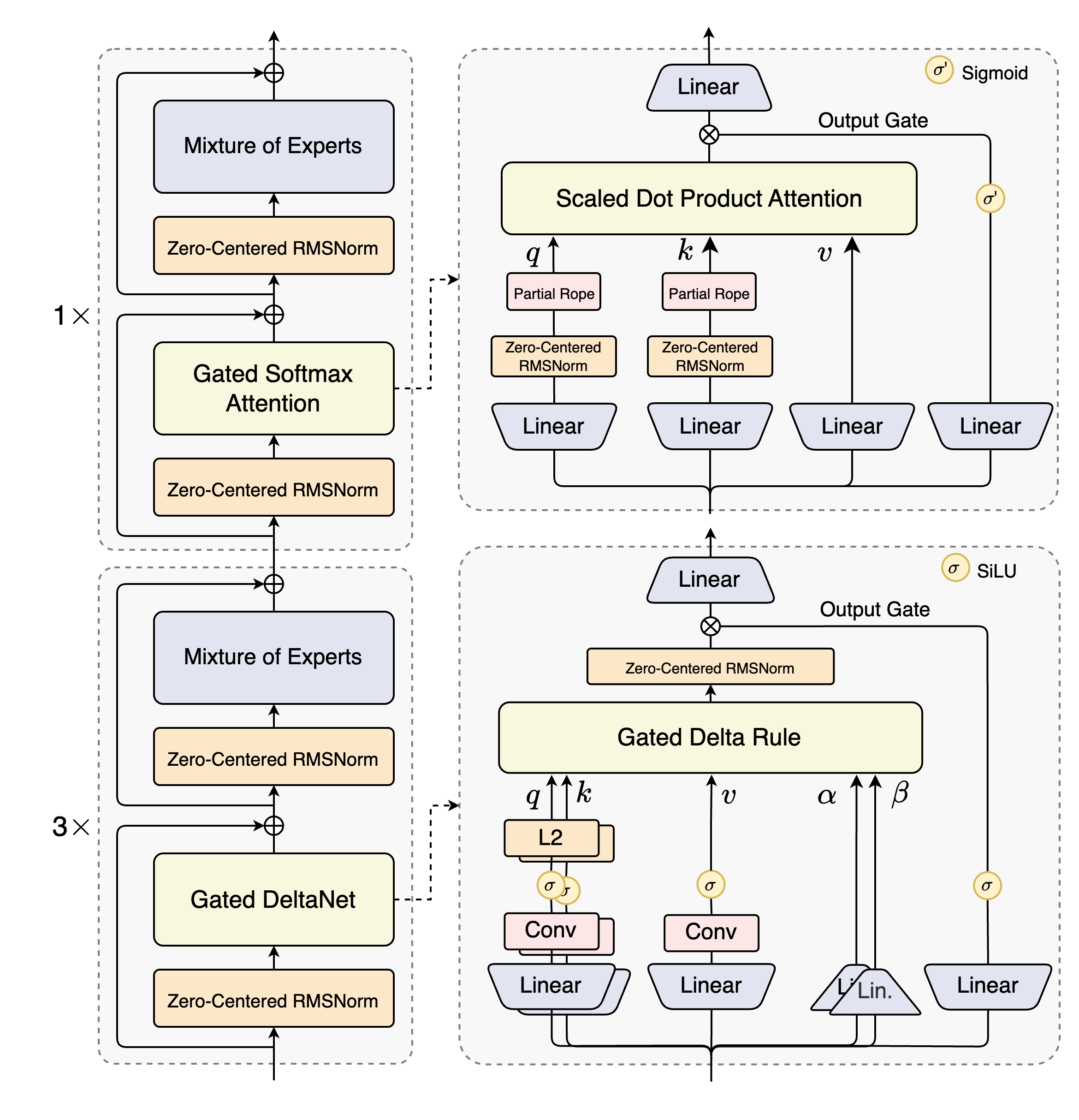
The Qwen3-Next-80B-A3B-Instruct has a hybrid layout with 48 layers and a 2048 hidden dimension. It uses a multi-token prediction mechanism for faster inference and has a causal language model type.
**Qwen3-Next-80B-A3B-Instruct** has the following features:
- Type: Causal Language Models
- Training Stage: Pretraining (15T tokens) & Post-training
- Number of Parameters: 80B in total and 3B activated
- Number of Paramaters (Non-Embedding): 79B
- Hidden Dimension: 2048
- Number of Layers: 48
- Hybrid Layout: 12 \* (3 \* (Gated DeltaNet -> MoE) -> 1 \* (Gated Attention -> MoE))
- Gated Attention:
- Number of Attention Heads: 16 for Q and 2 for KV
- Head Dimension: 256
- Rotary Position Embedding Dimension: 64
- Gated DeltaNet:
- Number of Linear Attention Heads: 32 for V and 16 for QK
- Head Dimension: 128
- Mixture of Experts:
- Number of Experts: 512
- Number of Activated Experts: 10
- Number of Shared Experts: 1
- Expert Intermediate Dimension: 512
- Context Length: 262,144 natively and extensible up to 1,010,000 tokens
 ## Quickstart
The code for Qwen3-Next has been merged into the main branch of Hugging Face `transformers`.
```shell
pip install git+https://github.com/huggingface/transformers.git@main
```
With earlier versions, you will encounter the following error:
```
KeyError: 'qwen3_next'
```
The following contains a code snippet illustrating how to use the model generate content based on given inputs.
```python
from transformers import AutoModelForCausalLM, AutoTokenizer
model_name = "Qwen/Qwen3-Next-80B-A3B-Instruct"
# load the tokenizer and the model
tokenizer = AutoTokenizer.from_pretrained(model_name)
model = AutoModelForCausalLM.from_pretrained(
model_name,
dtype="auto",
device_map="auto",
)
# prepare the model input
prompt = "Give me a short introduction to large language model."
messages = [
{"role": "user", "content": prompt},
]
text = tokenizer.apply_chat_template(
messages,
tokenize=False,
add_generation_prompt=True,
)
model_inputs = tokenizer([text], return_tensors="pt").to(model.device)
# conduct text completion
generated_ids = model.generate(
**model_inputs,
max_new_tokens=16384,
)
output_ids = generated_ids[0][len(model_inputs.input_ids[0]):].tolist()
content = tokenizer.decode(output_ids, skip_special_tokens=True)
print("content:", content)
```
> [!Note]
> Multi-Token Prediction (MTP) is not generally available in Hugging Face Transformers.
> [!Note]
> The efficiency or throughput improvement depends highly on the implementation.
> It is recommended to adopt a dedicated inference framework, e.g., SGLang and vLLM, for inference tasks.
> [!Tip]
> Depending on the inference settings, you may observe better efficiency with [`flash-linear-attention`](https://github.com/fla-org/flash-linear-attention#installation) and [`causal-conv1d`](https://github.com/Dao-AILab/causal-conv1d).
> See the links for detailed instructions and requirements.
## Deployment
For deployment, you can use the latest `sglang` or `vllm` to create an OpenAI-compatible API endpoint.
### SGLang
[SGLang](https://github.com/sgl-project/sglang) is a fast serving framework for large language models and vision language models.
SGLang could be used to launch a server with OpenAI-compatible API service.
`sglang>=0.5.2` is required for Qwen3-Next, which can be installed using:
```shell
pip install 'sglang[all]>=0.5.2'
```
See [its documentation](https://docs.sglang.ai/get_started/install.html) for more details.
The following command can be used to create an API endpoint at `http://localhost:30000/v1` with maximum context length 256K tokens using tensor parallel on 4 GPUs.
```shell
python -m sglang.launch_server --model-path Qwen/Qwen3-Next-80B-A3B-Instruct --port 30000 --tp-size 4 --context-length 262144 --mem-fraction-static 0.8
```
The following command is recommended for MTP with the rest settings the same as above:
```shell
python -m sglang.launch_server --model-path Qwen/Qwen3-Next-80B-A3B-Instruct --port 30000 --tp-size 4 --context-length 262144 --mem-fraction-static 0.8 --speculative-algo NEXTN --speculative-num-steps 3 --speculative-eagle-topk 1 --speculative-num-draft-tokens 4
```
> [!Note]
> The default context length is 256K. Consider reducing the context length to a smaller value, e.g., `32768`, if the server fails to start.
Please also refer to SGLang's usage guide on [Qwen3-Next](https://docs.sglang.ai/basic_usage/qwen3.html).
### vLLM
[vLLM](https://github.com/vllm-project/vllm) is a high-throughput and memory-efficient inference and serving engine for LLMs.
vLLM could be used to launch a server with OpenAI-compatible API service.
`vllm>=0.10.2` is required for Qwen3-Next, which can be installed using:
```shell
pip install 'vllm>=0.10.2'
```
See [its documentation](https://docs.vllm.ai/en/stable/getting_started/installation/index.html) for more details.
The following command can be used to create an API endpoint at `http://localhost:8000/v1` with maximum context length 256K tokens using tensor parallel on 4 GPUs.
```shell
vllm serve Qwen/Qwen3-Next-80B-A3B-Instruct --port 8000 --tensor-parallel-size 4 --max-model-len 262144
```
The following command is recommended for MTP with the rest settings the same as above:
```shell
vllm serve Qwen/Qwen3-Next-80B-A3B-Instruct --port 8000 --tensor-parallel-size 4 --max-model-len 262144 --speculative-config '{"method":"qwen3_next_mtp","num_speculative_tokens":2}'
```
> [!Note]
> The default context length is 256K. Consider reducing the context length to a smaller value, e.g., `32768`, if the server fails to start.
Please also refer to vLLM's usage guide on [Qwen3-Next](https://docs.vllm.ai/projects/recipes/en/latest/Qwen/Qwen3-Next.html).
## Agentic Use
Qwen3 excels in tool calling capabilities. We recommend using [Qwen-Agent](https://github.com/QwenLM/Qwen-Agent) to make the best use of agentic ability of Qwen3. Qwen-Agent encapsulates tool-calling templates and tool-calling parsers internally, greatly reducing coding complexity.
To define the available tools, you can use the MCP configuration file, use the integrated tool of Qwen-Agent, or integrate other tools by yourself.
```python
from qwen_agent.agents import Assistant
# Define LLM
llm_cfg = {
'model': 'Qwen3-Next-80B-A3B-Instruct',
# Use a custom endpoint compatible with OpenAI API:
'model_server': 'http://localhost:8000/v1', # api_base
'api_key': 'EMPTY',
}
# Define Tools
tools = [
{'mcpServers': { # You can specify the MCP configuration file
'time': {
'command': 'uvx',
'args': ['mcp-server-time', '--local-timezone=Asia/Shanghai']
},
"fetch": {
"command": "uvx",
"args": ["mcp-server-fetch"]
}
}
},
'code_interpreter', # Built-in tools
]
# Define Agent
bot = Assistant(llm=llm_cfg, function_list=tools)
# Streaming generation
messages = [{'role': 'user', 'content': 'https://qwenlm.github.io/blog/ Introduce the latest developments of Qwen'}]
for responses in bot.run(messages=messages):
pass
print(responses)
```
## Processing Ultra-Long Texts
Qwen3-Next natively supports context lengths of up to 262,144 tokens.
For conversations where the total length (including both input and output) significantly exceeds this limit, we recommend using RoPE scaling techniques to handle long texts effectively.
We have validated the model's performance on context lengths of up to 1 million tokens using the [YaRN](https://arxiv.org/abs/2309.00071) method.
YaRN is currently supported by several inference frameworks, e.g., `transformers`, `vllm` and `sglang`.
In general, there are two approaches to enabling YaRN for supported frameworks:
- Modifying the model files:
In the `config.json` file, add the `rope_scaling` fields:
```json
{
...,
"rope_scaling": {
"rope_type": "yarn",
"factor": 4.0,
"original_max_position_embeddings": 262144
}
}
```
- Passing command line arguments:
For `vllm`, you can use
```shell
VLLM_ALLOW_LONG_MAX_MODEL_LEN=1 vllm serve ... --rope-scaling '{"rope_type":"yarn","factor":4.0,"original_max_position_embeddings":262144}' --max-model-len 1010000
```
For `sglang`, you can use
```shell
SGLANG_ALLOW_OVERWRITE_LONGER_CONTEXT_LEN=1 python -m sglang.launch_server ... --json-model-override-args '{"rope_scaling":{"rope_type":"yarn","factor":4.0,"original_max_position_embeddings":262144}}' --context-length 1010000
```
> [!NOTE]
> All the notable open-source frameworks implement static YaRN, which means the scaling factor remains constant regardless of input length, **potentially impacting performance on shorter texts.**
> We advise adding the `rope_scaling` configuration only when processing long contexts is required.
> It is also recommended to modify the `factor` as needed. For example, if the typical context length for your application is 524,288 tokens, it would be better to set `factor` as 2.0.
#### Long-Context Performance
We test the model on an 1M version of the [RULER](https://arxiv.org/abs/2404.06654) benchmark.
| Model Name | Acc avg | 4k | 8k | 16k | 32k | 64k | 96k | 128k | 192k | 256k | 384k | 512k | 640k | 768k | 896k | 1000k |
|---------------------------------------------|---------|------|------|------|------|------|------|------|------|------|------|------|------|------|------|-------|
| Qwen3-30B-A3B-Instruct-2507 | 86.8 | 98.0 | 96.7 | 96.9 | 97.2 | 93.4 | 91.0 | 89.1 | 89.8 | 82.5 | 83.6 | 78.4 | 79.7 | 77.6 | 75.7 | 72.8 |
| Qwen3-235B-A22B-Instruct-2507 | 92.5 | 98.5 | 97.6 | 96.9 | 97.3 | 95.8 | 94.9 | 93.9 | 94.5 | 91.0 | 92.2 | 90.9 | 87.8 | 84.8 | 86.5 | 84.5 |
| Qwen3-Next-80B-A3B-Instruct | 91.8 | 98.5 | 99.0 | 98.0 | 98.7 | 97.6 | 95.0 | 96.0 | 94.0 | 93.5 | 91.7 | 86.9 | 85.5 | 81.7 | 80.3 | 80.3 |
* Qwen3-Next are evaluated with YaRN enabled. Qwen3-2507 models are evaluated with Dual Chunk Attention enabled.
* Since the evaluation is time-consuming, we use 260 samples for each length (13 sub-tasks, 20 samples for each).
## Best Practices
To achieve optimal performance, we recommend the following settings:
1. **Sampling Parameters**:
- We suggest using `Temperature=0.7`, `TopP=0.8`, `TopK=20`, and `MinP=0`.
- For supported frameworks, you can adjust the `presence_penalty` parameter between 0 and 2 to reduce endless repetitions. However, using a higher value may occasionally result in language mixing and a slight decrease in model performance.
2. **Adequate Output Length**: We recommend using an output length of 16,384 tokens for most queries, which is adequate for instruct models.
3. **Standardize Output Format**: We recommend using prompts to standardize model outputs when benchmarking.
- **Math Problems**: Include "Please reason step by step, and put your final answer within \boxed{}." in the prompt.
- **Multiple-Choice Questions**: Add the following JSON structure to the prompt to standardize responses: "Please show your choice in the `answer` field with only the choice letter, e.g., `"answer": "C"`."
## **Ethical Considerations**
NVIDIA believes Trustworthy AI is a shared responsibility and we have established policies and practices to enable development for a wide array of AI applications. When downloaded or used in accordance with our terms of service, developers should work with their internal model team to ensure this model meets requirements for the relevant industry and use case and addresses unforeseen product misuse.
Please report model quality, risk, security vulnerabilities or NVIDIA AI Concerns [here](https://www.nvidia.com/en-us/support/submit-security-vulnerability/)
## Prototype
```python
from openai import OpenAI
import json
client = OpenAI(
base_url="https://integrate.api.nvidia.com/v1",
api_key="$NVIDIA_API_KEY"
)
completion = client.chat.completions.create(
model="",
messages=[{"role":"user","content":""}],
temperature=,
top_p=,
max_tokens=,
stream=False
)
message = completion.choices[0].message
if message.content:
print(message.content)
```
```python
from langchain_nvidia_ai_endpoints import ChatNVIDIA
client = ChatNVIDIA(
model="",
api_key="$NVIDIA_API_KEY",
temperature=,
top_p=,
max_tokens=,
)
response = client.invoke([{"role":"user","content":""}])
if response.additional_kwargs and "reasoning_content" in response.additional_kwargs:
print(response.additional_kwargs["reasoning_content"])
print(response.content)
```
```javascript
import OpenAI from 'openai';
const openai = new OpenAI({
apiKey: '$NVIDIA_API_KEY',
baseURL: 'https://integrate.api.nvidia.com/v1',
});
async function main() {
const completion = await openai.chat.completions.create({
model: "",
messages: [{"role":"user","content":""}],
temperature: ,
top_p: ,
max_tokens: ,
stream: false
});
const message = completion.choices[0]?.message;
if (message?.content) {
console.log(message.content);
}
}
main().catch(console.error);
```
```bash
curl 'https://integrate.api.nvidia.com/v1/chat/completions' \
-H 'Content-Type: application/json' \
-H "Authorization: Bearer $NVIDIA_API_KEY" \
-d @- <<'EOF'
{"model":"qwen/qwen3-next-80b-a3b-instruct","messages":[{"role":"user","content":""}]}
EOF
```
## Quickstart
The code for Qwen3-Next has been merged into the main branch of Hugging Face `transformers`.
```shell
pip install git+https://github.com/huggingface/transformers.git@main
```
With earlier versions, you will encounter the following error:
```
KeyError: 'qwen3_next'
```
The following contains a code snippet illustrating how to use the model generate content based on given inputs.
```python
from transformers import AutoModelForCausalLM, AutoTokenizer
model_name = "Qwen/Qwen3-Next-80B-A3B-Instruct"
# load the tokenizer and the model
tokenizer = AutoTokenizer.from_pretrained(model_name)
model = AutoModelForCausalLM.from_pretrained(
model_name,
dtype="auto",
device_map="auto",
)
# prepare the model input
prompt = "Give me a short introduction to large language model."
messages = [
{"role": "user", "content": prompt},
]
text = tokenizer.apply_chat_template(
messages,
tokenize=False,
add_generation_prompt=True,
)
model_inputs = tokenizer([text], return_tensors="pt").to(model.device)
# conduct text completion
generated_ids = model.generate(
**model_inputs,
max_new_tokens=16384,
)
output_ids = generated_ids[0][len(model_inputs.input_ids[0]):].tolist()
content = tokenizer.decode(output_ids, skip_special_tokens=True)
print("content:", content)
```
> [!Note]
> Multi-Token Prediction (MTP) is not generally available in Hugging Face Transformers.
> [!Note]
> The efficiency or throughput improvement depends highly on the implementation.
> It is recommended to adopt a dedicated inference framework, e.g., SGLang and vLLM, for inference tasks.
> [!Tip]
> Depending on the inference settings, you may observe better efficiency with [`flash-linear-attention`](https://github.com/fla-org/flash-linear-attention#installation) and [`causal-conv1d`](https://github.com/Dao-AILab/causal-conv1d).
> See the links for detailed instructions and requirements.
## Deployment
For deployment, you can use the latest `sglang` or `vllm` to create an OpenAI-compatible API endpoint.
### SGLang
[SGLang](https://github.com/sgl-project/sglang) is a fast serving framework for large language models and vision language models.
SGLang could be used to launch a server with OpenAI-compatible API service.
`sglang>=0.5.2` is required for Qwen3-Next, which can be installed using:
```shell
pip install 'sglang[all]>=0.5.2'
```
See [its documentation](https://docs.sglang.ai/get_started/install.html) for more details.
The following command can be used to create an API endpoint at `http://localhost:30000/v1` with maximum context length 256K tokens using tensor parallel on 4 GPUs.
```shell
python -m sglang.launch_server --model-path Qwen/Qwen3-Next-80B-A3B-Instruct --port 30000 --tp-size 4 --context-length 262144 --mem-fraction-static 0.8
```
The following command is recommended for MTP with the rest settings the same as above:
```shell
python -m sglang.launch_server --model-path Qwen/Qwen3-Next-80B-A3B-Instruct --port 30000 --tp-size 4 --context-length 262144 --mem-fraction-static 0.8 --speculative-algo NEXTN --speculative-num-steps 3 --speculative-eagle-topk 1 --speculative-num-draft-tokens 4
```
> [!Note]
> The default context length is 256K. Consider reducing the context length to a smaller value, e.g., `32768`, if the server fails to start.
Please also refer to SGLang's usage guide on [Qwen3-Next](https://docs.sglang.ai/basic_usage/qwen3.html).
### vLLM
[vLLM](https://github.com/vllm-project/vllm) is a high-throughput and memory-efficient inference and serving engine for LLMs.
vLLM could be used to launch a server with OpenAI-compatible API service.
`vllm>=0.10.2` is required for Qwen3-Next, which can be installed using:
```shell
pip install 'vllm>=0.10.2'
```
See [its documentation](https://docs.vllm.ai/en/stable/getting_started/installation/index.html) for more details.
The following command can be used to create an API endpoint at `http://localhost:8000/v1` with maximum context length 256K tokens using tensor parallel on 4 GPUs.
```shell
vllm serve Qwen/Qwen3-Next-80B-A3B-Instruct --port 8000 --tensor-parallel-size 4 --max-model-len 262144
```
The following command is recommended for MTP with the rest settings the same as above:
```shell
vllm serve Qwen/Qwen3-Next-80B-A3B-Instruct --port 8000 --tensor-parallel-size 4 --max-model-len 262144 --speculative-config '{"method":"qwen3_next_mtp","num_speculative_tokens":2}'
```
> [!Note]
> The default context length is 256K. Consider reducing the context length to a smaller value, e.g., `32768`, if the server fails to start.
Please also refer to vLLM's usage guide on [Qwen3-Next](https://docs.vllm.ai/projects/recipes/en/latest/Qwen/Qwen3-Next.html).
## Agentic Use
Qwen3 excels in tool calling capabilities. We recommend using [Qwen-Agent](https://github.com/QwenLM/Qwen-Agent) to make the best use of agentic ability of Qwen3. Qwen-Agent encapsulates tool-calling templates and tool-calling parsers internally, greatly reducing coding complexity.
To define the available tools, you can use the MCP configuration file, use the integrated tool of Qwen-Agent, or integrate other tools by yourself.
```python
from qwen_agent.agents import Assistant
# Define LLM
llm_cfg = {
'model': 'Qwen3-Next-80B-A3B-Instruct',
# Use a custom endpoint compatible with OpenAI API:
'model_server': 'http://localhost:8000/v1', # api_base
'api_key': 'EMPTY',
}
# Define Tools
tools = [
{'mcpServers': { # You can specify the MCP configuration file
'time': {
'command': 'uvx',
'args': ['mcp-server-time', '--local-timezone=Asia/Shanghai']
},
"fetch": {
"command": "uvx",
"args": ["mcp-server-fetch"]
}
}
},
'code_interpreter', # Built-in tools
]
# Define Agent
bot = Assistant(llm=llm_cfg, function_list=tools)
# Streaming generation
messages = [{'role': 'user', 'content': 'https://qwenlm.github.io/blog/ Introduce the latest developments of Qwen'}]
for responses in bot.run(messages=messages):
pass
print(responses)
```
## Processing Ultra-Long Texts
Qwen3-Next natively supports context lengths of up to 262,144 tokens.
For conversations where the total length (including both input and output) significantly exceeds this limit, we recommend using RoPE scaling techniques to handle long texts effectively.
We have validated the model's performance on context lengths of up to 1 million tokens using the [YaRN](https://arxiv.org/abs/2309.00071) method.
YaRN is currently supported by several inference frameworks, e.g., `transformers`, `vllm` and `sglang`.
In general, there are two approaches to enabling YaRN for supported frameworks:
- Modifying the model files:
In the `config.json` file, add the `rope_scaling` fields:
```json
{
...,
"rope_scaling": {
"rope_type": "yarn",
"factor": 4.0,
"original_max_position_embeddings": 262144
}
}
```
- Passing command line arguments:
For `vllm`, you can use
```shell
VLLM_ALLOW_LONG_MAX_MODEL_LEN=1 vllm serve ... --rope-scaling '{"rope_type":"yarn","factor":4.0,"original_max_position_embeddings":262144}' --max-model-len 1010000
```
For `sglang`, you can use
```shell
SGLANG_ALLOW_OVERWRITE_LONGER_CONTEXT_LEN=1 python -m sglang.launch_server ... --json-model-override-args '{"rope_scaling":{"rope_type":"yarn","factor":4.0,"original_max_position_embeddings":262144}}' --context-length 1010000
```
> [!NOTE]
> All the notable open-source frameworks implement static YaRN, which means the scaling factor remains constant regardless of input length, **potentially impacting performance on shorter texts.**
> We advise adding the `rope_scaling` configuration only when processing long contexts is required.
> It is also recommended to modify the `factor` as needed. For example, if the typical context length for your application is 524,288 tokens, it would be better to set `factor` as 2.0.
#### Long-Context Performance
We test the model on an 1M version of the [RULER](https://arxiv.org/abs/2404.06654) benchmark.
| Model Name | Acc avg | 4k | 8k | 16k | 32k | 64k | 96k | 128k | 192k | 256k | 384k | 512k | 640k | 768k | 896k | 1000k |
|---------------------------------------------|---------|------|------|------|------|------|------|------|------|------|------|------|------|------|------|-------|
| Qwen3-30B-A3B-Instruct-2507 | 86.8 | 98.0 | 96.7 | 96.9 | 97.2 | 93.4 | 91.0 | 89.1 | 89.8 | 82.5 | 83.6 | 78.4 | 79.7 | 77.6 | 75.7 | 72.8 |
| Qwen3-235B-A22B-Instruct-2507 | 92.5 | 98.5 | 97.6 | 96.9 | 97.3 | 95.8 | 94.9 | 93.9 | 94.5 | 91.0 | 92.2 | 90.9 | 87.8 | 84.8 | 86.5 | 84.5 |
| Qwen3-Next-80B-A3B-Instruct | 91.8 | 98.5 | 99.0 | 98.0 | 98.7 | 97.6 | 95.0 | 96.0 | 94.0 | 93.5 | 91.7 | 86.9 | 85.5 | 81.7 | 80.3 | 80.3 |
* Qwen3-Next are evaluated with YaRN enabled. Qwen3-2507 models are evaluated with Dual Chunk Attention enabled.
* Since the evaluation is time-consuming, we use 260 samples for each length (13 sub-tasks, 20 samples for each).
## Best Practices
To achieve optimal performance, we recommend the following settings:
1. **Sampling Parameters**:
- We suggest using `Temperature=0.7`, `TopP=0.8`, `TopK=20`, and `MinP=0`.
- For supported frameworks, you can adjust the `presence_penalty` parameter between 0 and 2 to reduce endless repetitions. However, using a higher value may occasionally result in language mixing and a slight decrease in model performance.
2. **Adequate Output Length**: We recommend using an output length of 16,384 tokens for most queries, which is adequate for instruct models.
3. **Standardize Output Format**: We recommend using prompts to standardize model outputs when benchmarking.
- **Math Problems**: Include "Please reason step by step, and put your final answer within \boxed{}." in the prompt.
- **Multiple-Choice Questions**: Add the following JSON structure to the prompt to standardize responses: "Please show your choice in the `answer` field with only the choice letter, e.g., `"answer": "C"`."
## **Ethical Considerations**
NVIDIA believes Trustworthy AI is a shared responsibility and we have established policies and practices to enable development for a wide array of AI applications. When downloaded or used in accordance with our terms of service, developers should work with their internal model team to ensure this model meets requirements for the relevant industry and use case and addresses unforeseen product misuse.
Please report model quality, risk, security vulnerabilities or NVIDIA AI Concerns [here](https://www.nvidia.com/en-us/support/submit-security-vulnerability/)
## Prototype
```python
from openai import OpenAI
import json
client = OpenAI(
base_url="https://integrate.api.nvidia.com/v1",
api_key="$NVIDIA_API_KEY"
)
completion = client.chat.completions.create(
model="",
messages=[{"role":"user","content":""}],
temperature=,
top_p=,
max_tokens=,
stream=False
)
message = completion.choices[0].message
if message.content:
print(message.content)
```
```python
from langchain_nvidia_ai_endpoints import ChatNVIDIA
client = ChatNVIDIA(
model="",
api_key="$NVIDIA_API_KEY",
temperature=,
top_p=,
max_tokens=,
)
response = client.invoke([{"role":"user","content":""}])
if response.additional_kwargs and "reasoning_content" in response.additional_kwargs:
print(response.additional_kwargs["reasoning_content"])
print(response.content)
```
```javascript
import OpenAI from 'openai';
const openai = new OpenAI({
apiKey: '$NVIDIA_API_KEY',
baseURL: 'https://integrate.api.nvidia.com/v1',
});
async function main() {
const completion = await openai.chat.completions.create({
model: "",
messages: [{"role":"user","content":""}],
temperature: ,
top_p: ,
max_tokens: ,
stream: false
});
const message = completion.choices[0]?.message;
if (message?.content) {
console.log(message.content);
}
}
main().catch(console.error);
```
```bash
curl 'https://integrate.api.nvidia.com/v1/chat/completions' \
-H 'Content-Type: application/json' \
-H "Authorization: Bearer $NVIDIA_API_KEY" \
-d @- <<'EOF'
{"model":"qwen/qwen3-next-80b-a3b-instruct","messages":[{"role":"user","content":""}]}
EOF
```