
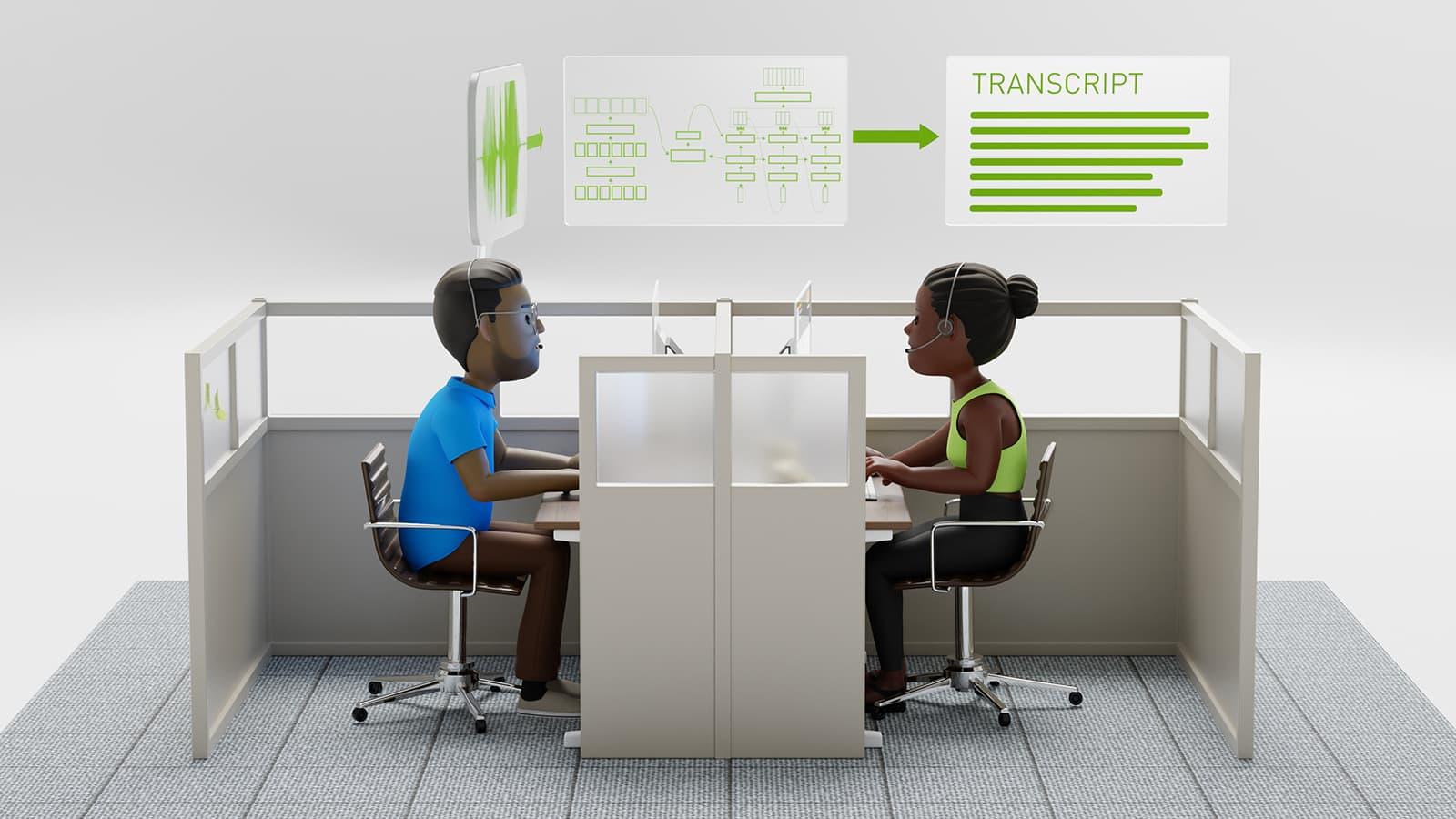
parakeet-tdt-0.6b-v2
DownloadableAccurate and optimized English transcriptions with punctuation and word timestamps
This NIM contains 2 profiles:
- nvidia/parakeet-tdt-0.6b-v2 (English only)
- nvidia/parakeet-tdt-0.6b-v3 (25 European languages)
Parakeet-tdt-0.6b-v2 is a 600-million-parameter automatic speech recognition (ASR) model designed for high-quality English transcription, featuring support for punctuation, capitalization, and accurate timestamp prediction.
This XL variant of the FastConformer architecture integrates the TDT decoder and is trained with full attention, enabling efficient transcription of audio segments up to 24 minutes in a single pass.
Key Features:
- Accurate word-level timestamp predictions
- Automatic punctuation and capitalization
- Robust performance on spoken numbers, and song lyrics transcription
GOVERNING TERMS: Use of this Parakeet-tdt-0.6b-v2 is governed by the NVIDIA Community Model License Agreement (found at NVIDIA Agreements | Enterprise Software | NVIDIA Community Model License).
Parakeet-tdt-0.6b-v3 is a 600-million-parameter multilingual automatic speech recognition (ASR) model designed for high-throughput speech-to-text transcription. It extends the parakeet-tdt-0.6b-v2 model by expanding language support from English to 25 European languages. The model automatically detects the language of the audio and transcribes it without requiring additional prompting. It is part of a series of models that leverage the Granary [1, 2] multilingual corpus as their primary training dataset.
Key Features:
Parakeet-tdt-0.6b-v3's key features are built on the foundation of its predecessor, Parakeet-tdt-0.6b-v2, and include:
- Automatic punctuation and capitalization
- Accurate word-level and segment-level timestamps
- Long audio transcription, supporting audio up to 24 minutes long with full attention (on A100 80GB) or up to 3 hours with local attention.
Try the experience here: https://huggingface.co/spaces/nvidia/parakeet-tdt-0.6b-v3
Supported Languages:
Bulgarian (bg), Croatian (hr), Czech (cs), Danish (da), Dutch (nl), English (en), Estonian (et), Finnish (fi), French (fr), German (de, Greek (el), Hungarian (hu), Italian (it), Latvian (lv), Lithuanian (lt), Maltese (mt), Polish (pl), Portuguese (pt), Romanian (ro), Slovak (sk), Slovenian (sl), Spanish (es), Swedish (sv), Russian (ru), Ukrainian (uk)
GOVERNING TERMS: Use of this Parakeet-tdt-0.6b-v3 is governed by the NVIDIA open model licence agreement (found at NVIDIA Open Model License Agreement).
Automatic Speech Recognition (ASR) Performance
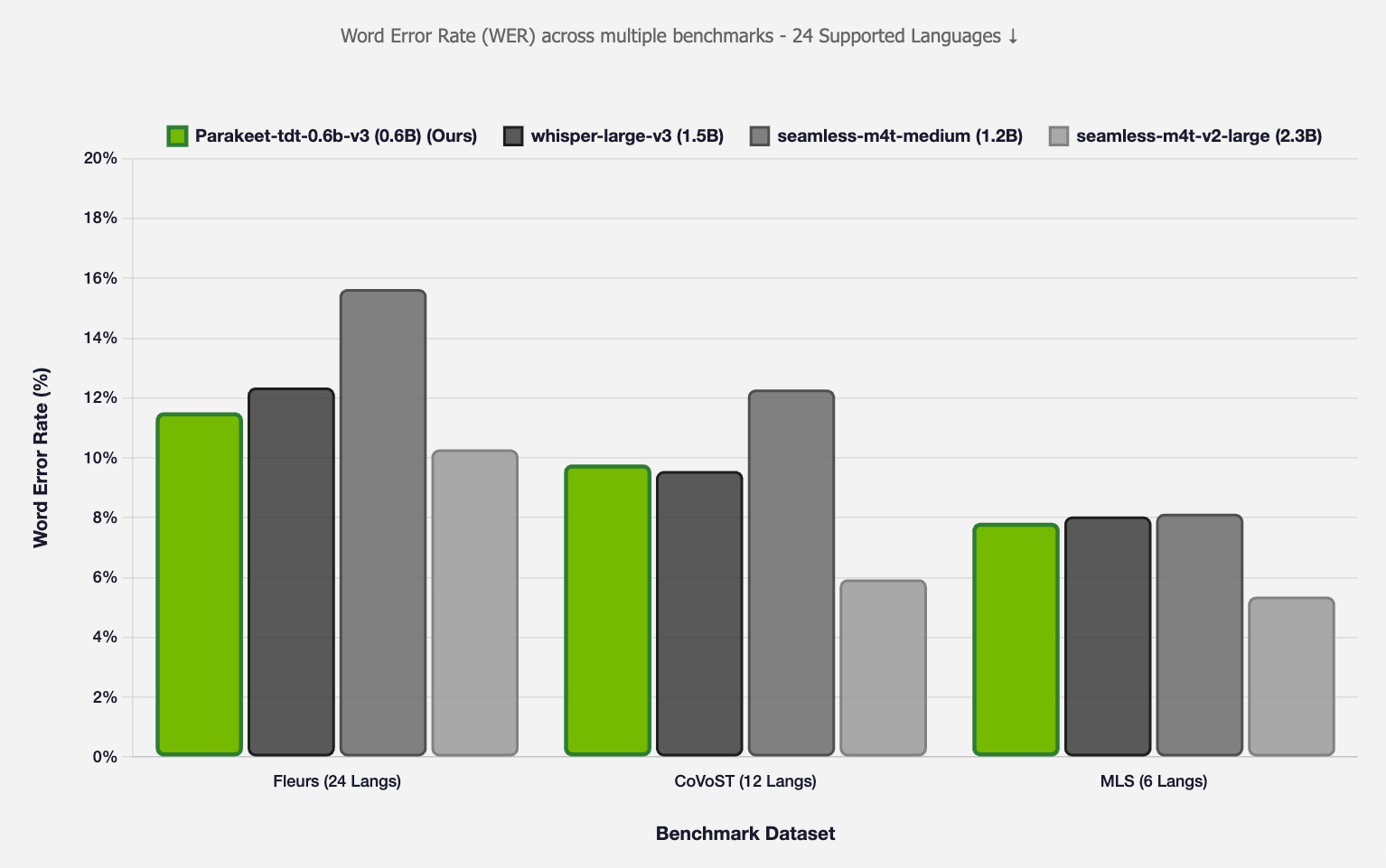
Figure 1: ASR WER comparison across different models. This does not include Punctuation and Capitalisation errors.
Evaluation Notes
Note 1: The above evaluations are conducted for 24 supported languages, excluding Latvian since seamless-m4t-v2-large and seamless-m4t-medium do not support it.
Note 2: Performance differences may be partly attributed to Portuguese variant differences - our training data uses European Portuguese while most benchmarks use Brazilian Portuguese.
Deployment Geography:
Global
Use Case:
This model serves developers, researchers, academics, and industries building applications that require speech-to-text capabilities, including but not limited to: conversational AI, voice assistants, transcription services, subtitle generation, and voice analytics platforms.
Release Date:
Huggingface 08/14/2025
Model Architecture:
Architecture Type:
FastConformer-TDT
Network Architecture:
- This model was developed based on FastConformer encoder architecture[3] and TDT decoder[4]
- This model has 600 million model parameters.
Input:
Input Type(s): 16kHz Audio
Input Format(s): .wav and .flac audio formats
Input Parameters: 1D (audio signal)
Other Properties Related to Input: Monochannel audio
Output:
Output Type(s): Text Output Format: String Output Parameters: 1D (text) Other Properties Related to Output: Punctuations and Capitalizations included.
Our AI models are designed and/or optimized to run on NVIDIA GPU-accelerated systems. By leveraging NVIDIA's hardware (e.g. GPU cores) and software frameworks (e.g., CUDA libraries), the model achieves faster training and inference times compared to CPU-only solutions.
For more information, refer to the NeMo documentation.
How to Use this Model:
To train, fine-tune or play with the model you will need to install NVIDIA NeMo. We recommend you install it after you've installed latest PyTorch version.
pip install -U nemo_toolkit['asr']
The model is available for use in the NeMo toolkit [5], and can be used as a pre-trained checkpoint for inference or for fine-tuning on another dataset.
Automatically instantiate the model
import nemo.collections.asr as nemo_asr
asr_model = nemo_asr.models.ASRModel.from_pretrained(model_name="nvidia/parakeet-tdt-0.6b-v3")
Transcribing using Python
First, let's get a sample
wget https://dldata-public.s3.us-east-2.amazonaws.com/2086-149220-0033.wav
Then simply do:
output = asr_model.transcribe(['2086-149220-0033.wav'])
print(output[0].text)
Transcribing with timestamps
To transcribe with timestamps:
output = asr_model.transcribe(['2086-149220-0033.wav'], timestamps=True)
# by default, timestamps are enabled for char, word and segment level
word_timestamps = output[0].timestamp['word'] # word level timestamps for first sample
segment_timestamps = output[0].timestamp['segment'] # segment level timestamps
char_timestamps = output[0].timestamp['char'] # char level timestamps

for stamp in segment_timestamps:
    print(f"{stamp['start']}s - {stamp['end']}s : {stamp['segment']}")
Transcribing long-form audio
#updating self-attention model of fast-conformer encoder
#setting attention left and right context sizes to 256
asr_model.change_attention_model(self_attention_model="rel_pos_local_attn", att_context_size=[256, 256])

output = asr_model.transcribe(['2086-149220-0033.wav'])

print(output[0].text)
Software Integration:
Runtime Engine(s):
- NeMo 2.2
Supported Hardware Microarchitecture Compatibility:
- NVIDIA Ampere
- NVIDIA Blackwell
- NVIDIA Hopper
- NVIDIA Volta
[Preferred/Supported] Operating System(s):
- Linux
Hardware Specific Requirements:
Atleast 2GB RAM for model to load. The bigger the RAM, the larger audio input it supports.
Model Version
Current version: parakeet-tdt-0.6b-v3. Previous versions can be accessed here.
Training and Evaluation Datasets:
Training
This model was trained using the NeMo toolkit [5], following the strategies below:
- Initialized from a CTC multilingual checkpoint pretrained on the Granary dataset [1] [2].
- Trained for 150,000 steps on 128 A100 GPUs.
- Dataset corpora and languages were balanced using a temperature sampling value of 0.5.
- Stage 2 fine-tuning was performed for 5,000 steps on 4 A100 GPUs using approximately 7,500 hours of high-quality, human-transcribed data of NeMo ASR Set 3.0.
Training was conducted using this example script and TDT configuration.
During the training, a unified SentencePiece Tokenizer [6] with a vocabulary of 8,192 tokens was used. The unified tokenizer was constructed from the training set transcripts using this script and was optimized across all 25 supported languages.
Training Dataset
The model was trained on the combination of Granary dataset's ASR subset and in-house dataset NeMo ASR Set 3.0:
-
10,000 hours from human-transcribed NeMo ASR Set 3.0, including:
- LibriSpeech (960 hours)
- Fisher Corpus
- National Speech Corpus Part 1
- VCTK
- Europarl-ASR
- Multilingual LibriSpeech
- Mozilla Common Voice (v7.0)
- AMI
-
660,000 hours of pseudo-labeled data from Granary [1] [2], including:
All transcriptions preserve punctuation and capitalization. The Granary dataset will be made publicly available after presentation at Interspeech 2025.
Data Collection Method by dataset
- Hybrid: Automated, Human
Labeling Method by dataset
- Hybrid: Synthetic, Human
Properties:
- Noise robust data from various sources
- Single channel, 16kHz sampled data
Evaluation Datasets
For multilingual ASR performance evaluation:
- Fleurs [10]
- MLS [11]
- CoVoST [12]
For English ASR performance evaluation:
- Hugging Face Open ASR Leaderboard [13] datasets
Data Collection Method by dataset
- Human
Labeling Method by dataset
- Human
Properties:
- All are commonly used for benchmarking English ASR systems.
- Audio data is typically processed into a 16kHz mono channel format for ASR evaluation, consistent with benchmarks like the Open ASR Leaderboard.
Performance
Multilingual ASR
The tables below summarizes the WER (%) using a Transducer decoder with greedy decoding (without an external language model):
| Language | Fleurs | MLS | CoVoST |
|---|---|---|---|
| Average WER ↓ | 11.97% | 7.83% | 11.98% |
| bg | 12.64% | - | - |
| cs | 11.01% | - | - |
| da | 18.41% | - | - |
| de | 5.04% | - | 4.84% |
| el | 20.70% | - | - |
| en | 4.85% | - | 6.80% |
| es | 3.45% | 4.39% | 3.41% |
| et | 17.73% | - | 22.04% |
| fi | 13.21% | - | - |
| fr | 5.15% | 4.97% | 6.05% |
| hr | 12.46% | - | - |
| hu | 15.72% | - | - |
| it | 3.00% | 10.08% | 3.69% |
| lt | 20.35% | - | - |
| lv | 22.84% | - | 38.36% |
| mt | 20.46% | - | - |
| nl | 7.48% | 12.78% | 6.50% |
| pl | 7.31% | 7.28% | - |
| pt | 4.76% | 7.50% | 3.96% |
| ro | 12.44% | - | - |
| ru | 5.51% | - | 3.00% |
| sk | 8.82% | - | - |
| sl | 24.03% | - | 31.80% |
| sv | 15.08% | - | 20.16% |
| uk | 6.79% | - | 5.10% |
Note: WERs are calculated after removing Punctuation and Capitalization from reference and predicted text.
Huggingface Open-ASR-Leaderboard
| Model | Avg WER | AMI | Earnings-22 | GigaSpeech | LS test-clean | LS test-other | SPGI Speech | TEDLIUM-v3 | VoxPopuli |
|---|---|---|---|---|---|---|---|---|---|
parakeet-tdt-0.6b-v3 | 6.34% | 11.31% | 11.42% | 9.59% | 1.93% | 3.59% | 3.97% | 2.75% | 6.14% |
Additional evaluation details are available on the Hugging Face ASR Leaderboard.[13]
Noise Robustness
Performance across different Signal-to-Noise Ratios (SNR) using MUSAN music and noise samples [14]:
| SNR Level | Avg WER | AMI | Earnings | GigaSpeech | LS test-clean | LS test-other | SPGI | Tedlium | VoxPopuli | Relative Change |
|---|---|---|---|---|---|---|---|---|---|---|
| Clean | 6.34% | 11.31% | 11.42% | 9.59% | 1.93% | 3.59% | 3.97% | 2.75% | 6.14% | - |
| SNR 10 | 7.12% | 13.99% | 11.79% | 9.96% | 2.15% | 4.55% | 4.45% | 3.05% | 6.99% | -12.28% |
| SNR 5 | 8.23% | 17.59% | 13.01% | 10.69% | 2.62% | 6.05% | 5.23% | 3.33% | 7.31% | -29.81% |
| SNR 0 | 11.66% | 24.44% | 17.34% | 13.60% | 4.82% | 10.38% | 8.41% | 5.39% | 8.91% | -83.97% |
| SNR -5 | 19.88% | 34.91% | 26.92% | 21.41% | 12.21% | 19.98% | 16.96% | 11.36% | 15.30% | -213.64% |
References
[1] Granary: Speech Recognition and Translation Dataset in 25 European Languages
[2] NVIDIA Granary Dataset Card
[3] Fast Conformer with Linearly Scalable Attention for Efficient Speech Recognition
[4] Efficient Sequence Transduction by Jointly Predicting Tokens and Durations
[6] Google Sentencepiece Tokenizer
[7] Youtube-Commons
[8] MOSEL: 950,000 Hours of Speech Data for Open-Source Speech Foundation Model Training on EU Languages
[9] YODAS: Youtube-Oriented Dataset for Audio and Speech
[10] FLEURS: Few-shot Learning Evaluation of Universal Representations of Speech
[11] MLS: A Large-Scale Multilingual Dataset for Speech Research
[12] CoVoST 2 and Massively Multilingual Speech-to-Text Translation
[13] HuggingFace ASR Leaderboard
[14] MUSAN: A Music, Speech, and Noise Corpus
Inference:
Engine:
- NVIDIA NeMo
Test Hardware:
- NVIDIA A10
- NVIDIA A100
- NVIDIA A30
- NVIDIA H100
- NVIDIA L4
- NVIDIA L40
- NVIDIA Turing T4
- NVIDIA Volta V100
Ethical Considerations:
NVIDIA believes Trustworthy AI is a shared responsibility and we have established policies and practices to enable development for a wide array of AI applications. When downloaded or used in accordance with our terms of service, developers should work with their supporting model team to ensure this model meets requirements for the relevant industry and use case and addresses unforeseen product misuse.
For more detailed information on ethical considerations for this model, please see the Model Card++ Explainability, Bias, Safety & Security, and Privacy Subcards here.
Please report security vulnerabilities or NVIDIA AI Concerns here.