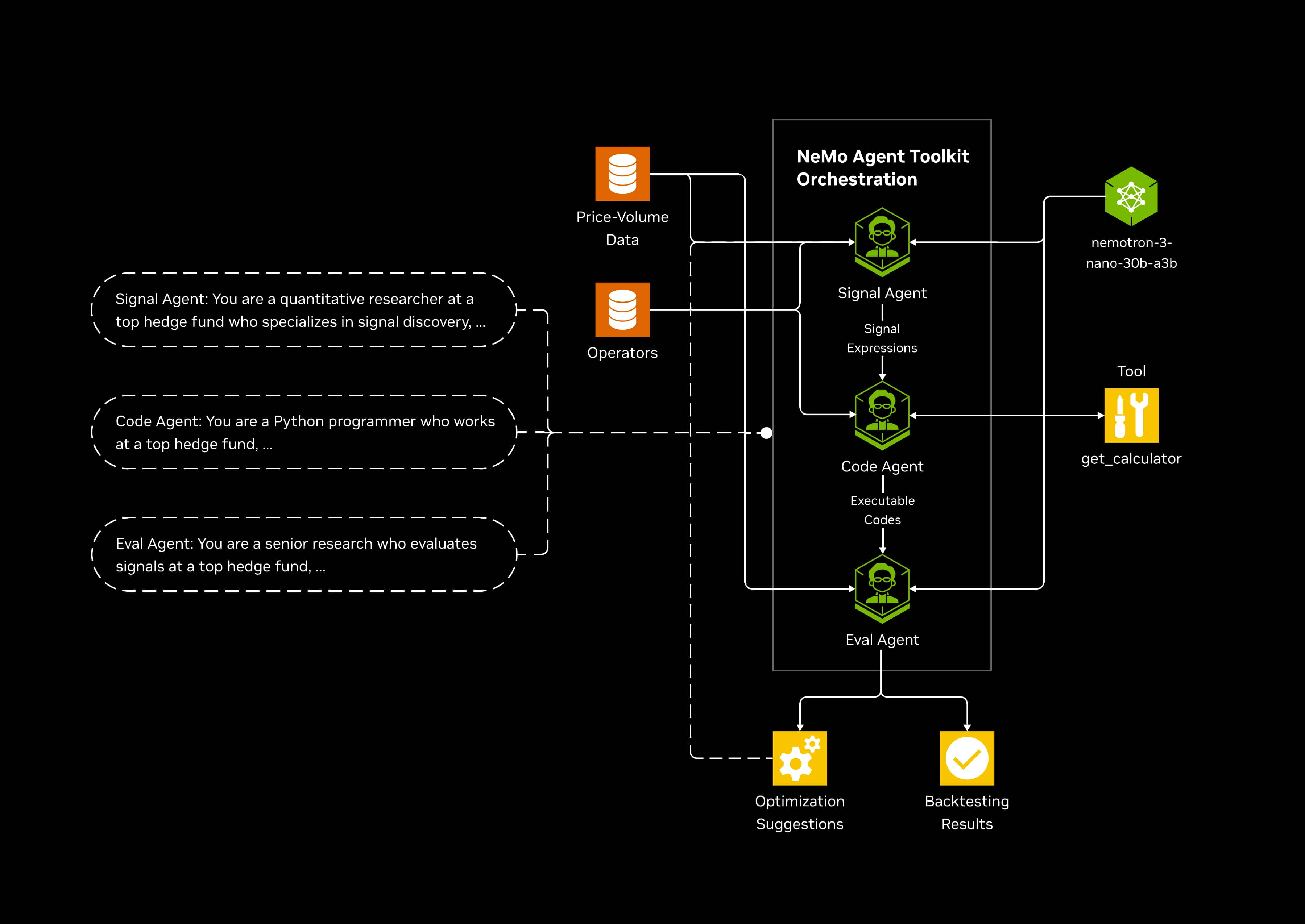
The Quantitative Signal Discovery Agent developer example demonstrates how to automate signal discovery—a core workflow in quantitative trading—using an agentic architecture built with NVIDIA Nemotron family of open models and the NVIDIA NeMo Agent Toolkit open-source library.
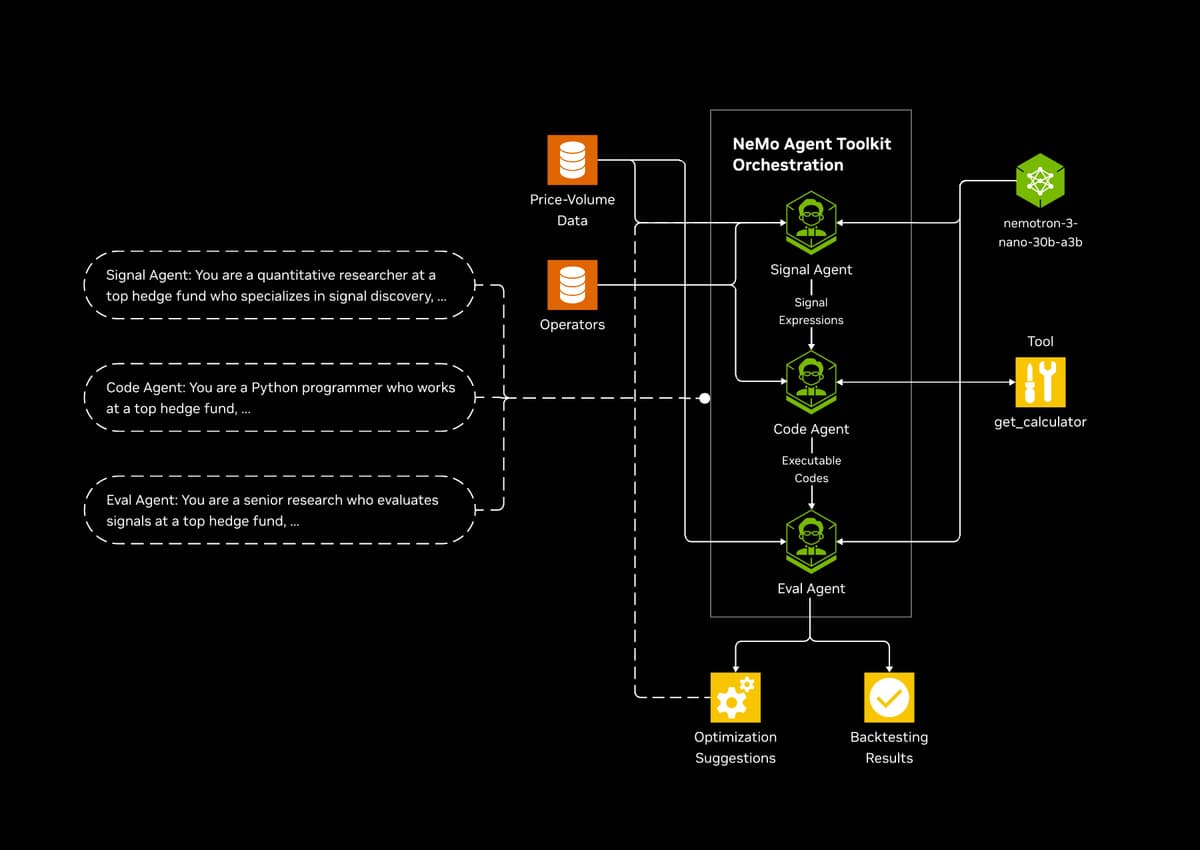
The system coordinates three specialized agents:
- Signal agent: Identifies potential alpha signals from real market data.
- Code agent: Translates signal descriptions into executable Python code.
- Evaluation agent: Runs backtests, applies logical evaluation, and iteratively refines signal suggestions.
Together, these agents form a closed-loop system that continuously mines, tests, and improves trading signals. Using NVIDIA NeMo Agent Toolkit, developers can streamline orchestration, track performance and identify bottlenecks, and simplify deployment of this multi-agent workflow for quantitative research.
Architecture Diagram
Key Features
- Autonomous Multi-Agent Orchestration: Coordinate Signal, Code, and Eval Agents using the NeMo Agent Toolkit, enabling automation of complex, multi-stage reasoning and continuous signal discovery.
- Self-Correcting Code Generation: Generate executable Python from signal logic with built-in error-handling, iterative refinement, and reliability at scale.
- Reduced Latency and Cost: Deploys lightweight NIM microservices optimized for throughput and efficiency—reducing GPU demand, inference cost, and energy use without compromising performance.
- Accelerated Backtesting and Strategy Evaluation: Iterate faster using NVIDIA CUDA-X Data Science libraries for signal testing, validation, and selection.
- Scalable, Observable Experimentation: Gain experiment tracking and performance monitoring with NeMo Agent Toolkit, supporting reproducible research.
- Modular Integration and Deployment: Integrate seamlessly with existing quant pipelines using a modular design supporting on-premises, hybrid cloud, and edge deployments.
Minimum System Requirements
Hardware Requirements
- GPU: 1x NVIDIA GPU with 48GB+ VRAM (e.g., A100 80GB, H100) for local NIM deployment
- RAM: 16 GB
- Storage: 5 GB free disk space (for S&P 500 data and model outputs)
- Note: If using the hosted NIM API at build.nvidia.com, no local GPU is required. The workflow runs CPU-only and calls the NIM inference endpoint remotely. Additionally, a Milvus vector database instance is required for product catalog embeddings, and Arize Phoenix is recommended for distributed tracing and observability across the multi-agent workflow.
OS
- Linux (Ubuntu 22.04+), macOS, or Windows
Deployment Options
- Python virtual environment (pip or uv)
- Jupyter Notebook
Software Used in This Blueprint
NVIDIA Technology
- NVIDIA NeMo Agent Toolkit (NAT) — Multi-agent workflow orchestration, composing Signal, Code, and Eval agents in a closed-loop optimization pipeline
- NVIDIA NIM (nemotron-3-nano-30b-a3b) — Open, efficient MoE model with 1M context, excelling in coding, reasoning, instruction following, tool calling, and more
- Arize Phoenix (with NVIDIA NAT integration) — LLM observability, tracing, and debugging
3rd Party Software
- LangChain — LLM framework for agent-model interaction
- pandas — DataFrame operations for price-volume data processing
- NumPy — Array operations across signal computation and evaluation
- SciPy — Statistical analysis (Spearman correlation, t-tests, p-values)
- yfinance — S&P 500 price-volume data downloaded from Yahoo Finance
- Arize Phoenix — Open-source LLM observability and tracing platform
- OpenInference — LangChain instrumentation for trace capture
- Jupyter — Interactive notebook environment for exploration and visualization
License
By using this software, you are agreeing to the terms and conditions of the license and acceptable use policy.
GOVERNING TERMS: This developer example is governed by the NVIDIA Software License Agreement and Product Specific Terms for AI Products.
This project will download and install additional third-party open source software projects. Review the license terms of these open source projects before use.
Please report security vulnerabilities or NVIDIA AI concerns here.