
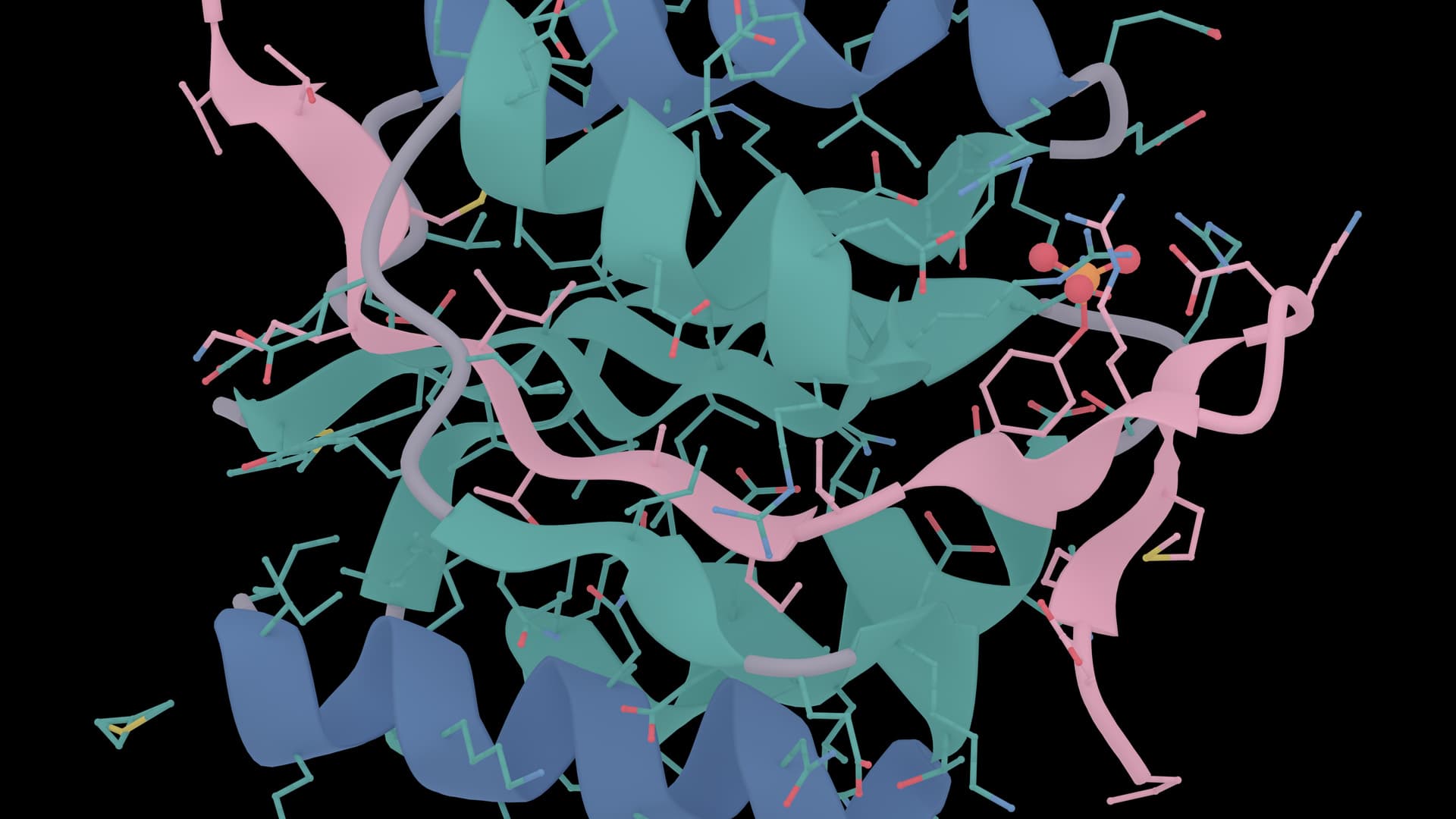
rfd4-proteina
Free EndpointA unified generative model for protein, enzyme, binder and antibody design.
Model Overview
Description:
RFD4-Proteina is a unified generative model for protein design, produced through a
collaboration between NVIDIA's Generative AI team and the David Baker Lab at the
Institute for Protein Design. Rather than screening existing molecules, it creates
them: users express structural, sequence and chemical constraints, then generate,
score and search for molecules that satisfy their objectives.
This deployment serves seven design tasks — generation, motif
scaffolding, enzyme design, small-molecule binder design, antibody design, partial
diffusion and inverse folding — and supports reward-guided beam search over the
diffusion trajectory, so a request can optimise against locally computable metrics
rather than returning a single unranked sample.
This model is ready for commercial or non-commercial use.
Third-Party Community Consideration
This model is not owned or developed by NVIDIA. This model has been developed and
built to a third-party's requirements for this application and use case; see link to Non-NVIDIA Institute for Protein Design RFD4-Proteina Model Card.
License/Terms of Use:
GOVERNING TERMS: This trial service is governed by the NVIDIA API Trial Service Terms of Use. Use of this model is governed by the BSD 3-Clause License, Copyright (c) 2026, Institute for Protein Design, University of Washington.
You are responsible for ensuring that your use of NVIDIA AI Foundation Models complies with all applicable laws.
Deployment Geography:
Global
Use Case
RFD4-Proteina is used by academic and pharmaceutical industry research labs for de novo protein, enzyme, binder and antibody design, supporting early-stage biologic discovery: scaffolding a functional site, designing a binder against a known target, or resampling a sequence for an existing backbone.
Release Date
- build.nvidia.com 10/20/2026 (NVIDIA GTC Berlin) via build.nvidia.com/ipd/rfd4-proteina
- NGC 10/20/2026 (NVIDIA GTC Berlin) via catalog.ngc.nvidia.com/orgs/nim/teams/ipd/containers/rfd4-proteina
References:
@article{Watson2023,
  author  = {Watson, Joseph L. and Juergens, David and Bennett, Nathaniel R. and Trippe, Brian L. and Yim, Jason and Eisenach, Helen E. and Ahern, Woody and Borst, Andrew J. and Ragotte, Robert J. and Milles, Lukas F. and Wicky, Basile I. M. and Hanikel, Nikita and Pellock, Samuel J. and Courbet, Alexis and Sheffler, William and Wang, Jue and Venkatesh, Preetham and Sappington, Isaac and Torres, Susana Vázquez and Lauko, Anna and De Bortoli, Valentin and Mathieu, Emile and Ovchinnikov, Sergey and Barzilay, Regina and Jaakkola, Tommi S. and DiMaio, Frank and Baek, Minkyung and Baker, David},
  journal = {Nature},
  title   = {De novo design of protein structure and function with RFdiffusion},
  year    = {2023},
  volume  = {620},
  pages   = {1089--1100},
  doi     = {10.1038/s41586-023-06415-8}
}
Model Architecture:
Architecture Type: Other
Network Architecture: RFD4-Proteina, a latent-space flow-matching generative model
** Number of model parameters: 4.34×10⁸ (trunk 1.78×10⁸, autoencoder 2.56×10⁸)
The trunk runs inside a latent space produced by a paired autoencoder. The default
composition uses the thinking_medium recycle schedule: 60 sampling steps with
recycle depth peaking at 6 through the middle of the trajectory, 185 trunk passes
in total, so compute concentrates where the fold is decided rather than on the
noisy start or the already-settled end. thinking_low and thinking_high trade
that budget down and up. The released checkpoint has self-conditioning off and
carries no MSA module.
Input:
Input Type(s): Text (protein structure and design specification)
Input Format(s): annotated mmCIF; condition spec
Input Parameters: One-Dimensional (1D)
Other Properties Related to Input: Design length up to 1024 tokens; attached structures are named files carried in the request body
Two input dialects sit behind a format discriminator. An annotated mmCIF carries
the design conditions inside the file; a condition spec states them as selections
over an attached structure. Attached structures are named files carried in the
request body, never filesystem paths.
Output:
Output Type(s): Text (protein structure and sequence)
Output Format: annotated mmCIF, plus per-design metrics
Output Parameters: One-Dimensional (1D)
Other Properties Related to Output: Per-design metrics (for example clash fraction, bond-length violations and sequence adherence) are returned alongside each structure
Our AI models are designed and/or optimized to run on NVIDIA GPU-accelerated systems. By leveraging NVIDIA's hardware (e.g. GPU cores) and software frameworks (e.g., CUDA libraries), the model achieves faster inference times compared to CPU-only solutions.
Tasks
| Task | What it does |
|---|---|
generation | Generated regions start from noise while any supplied conditions are preserved; covers de novo monomers and conditional designs alike, including protein and DNA binders |
motif_scaffolding | A scaffold around motif segments held at their given positions |
enzyme_design | Scaffold an unindexed catalytic site, the model choosing placement |
small_molecule_binder | A protein around an atomized small molecule at its given pose |
antibody_design | Redesign CDR loops on a fixed Ig framework, optionally against a fixed antigen; also covers TCRs |
partial_diffusion | Refine an existing design by restarting the trajectory partway |
inverse_folding | Hold the backbone, resample sequence and side chains |
task selects how the sampler runs the trajectory, not which design problem is
being solved. Several problems need no task of their own because they are
expressed by what the input holds fixed: a protein binder against a target is
generation with the target's atoms held by coordinate and sequence
conditioning and its epitope marked as hotspots.
Reward-guided search
Search is not best-of-N. At each checkpoint every surviving candidate is branched,
each branch is rolled out to a clean structure to be scored, and the best
beam_width survive. Compute concentrates on trajectories that are going
somewhere, which is why it beats filtering at equal budget. Cost is roughly
beam_width * n_branch * (len(step_checkpoints) - 1) rollouts per replicate.
This deployment serves the in-repository, non-oracle metrics by default. Oracle-backed refolding metrics require an operator-mounted structure-prediction model and are not part of the default deployment.
Software Integration:
Runtime Engine(s):
- NVIDIA NIM
- PyTorch
Supported Hardware Microarchitecture Compatibility:
- NVIDIA Ampere
- NVIDIA Blackwell
- NVIDIA Hopper
- NVIDIA Lovelace
Supported Operating System(s):
- Linux
The integration of foundation and fine-tuned models into AI systems requires
additional testing using use-case-specific data to ensure safe and effective
deployment. Following the V-model (a development methodology), iterative testing and validation at
both unit and system levels are essential to mitigate risks, meet technical and
functional requirements, and ensure compliance with safety and ethical standards
before deployment.
Model Version(s):
- Institute for Protein Design trained weights
- RFD4-Proteina version 1.0.0
Training and Evaluation Datasets:
Training Dataset:
** Data Modality
- [Other: Protein 3D structures and sequences]
** Training Data Size
- Undisclosed (third-party)
Link: Institute for Protein Design RFD4-Proteina
This model's weights were trained by the Institute for Protein Design and are not collected, curated, or retrained by NVIDIA. For the RFdiffusion backbone-generation approach this model builds on, see Watson et al. 2023.
** Data Collection Method by dataset
- Undisclosed
** Labeling Method by dataset
- Undisclosed
Properties: The training data composition, count and content are not disclosed by the Institute for Protein Design. The data is structural (protein 3D structures and sequences) and contains no natural-language text.
Evaluation Dataset:
Link: Institute for Protein Design RFD4-Proteina
** Data Collection Method by dataset
- Undisclosed
** Labeling Method by dataset
- Undisclosed
Properties: Design-quality evaluation of this model was performed by the Institute for Protein Design and is not reproduced by NVIDIA; its dataset count and composition are not disclosed. The data is structural (protein, enzyme, small-molecule-binder and motif-scaffolding design targets) and contains no natural-language text.
Testing Dataset:
Link: Institute for Protein Design RFD4-Proteina
** Data Collection Method by dataset
- Undisclosed
** Labeling Method by dataset
- Undisclosed
Properties: NVIDIA's own verification of this NIM deployment uses 87 annotated mmCIF design inputs drawn from 12 conditioning families authored by the Institute for Protein Design: motif scaffolding (50 inputs), unconditional and secondary-structure-conditioned generation (25) and small-molecule-binder and interchain-interaction conditioning (12). Each input is a protein structure, optionally with a ligand, and contains no natural-language text. It checks that each supported task returns a valid, physically finite structure under the metrics the NIM reports; it is a functional check, not a design-quality benchmark.
Inference:
Acceleration Engine: PyTorch, NVIDIA BioNeMo Inference Runtime (BioIR)
Test Hardware:
- NVIDIA A100
- NVIDIA B200
- NVIDIA B300
- NVIDIA DGX Spark (GB10)
- NVIDIA GB200
- NVIDIA GB300
- NVIDIA GH200
- NVIDIA H100
- NVIDIA H200
- NVIDIA L40S
- NVIDIA RTX 6000 Ada Generation
- NVIDIA RTX PRO 6000 Blackwell Server Edition
- NVIDIA RTX PRO 6000 Blackwell Workstation Edition
Ethical Considerations:
NVIDIA believes Trustworthy AI is a shared responsibility and we have established policies and practices to enable development for a wide array of AI applications. Developers should work with their internal model team to ensure this model meets requirements for the relevant industry and use case and addresses unforeseen product misuse.
Users are responsible for ensuring the physical properties of model-generated molecules are appropriately evaluated and comply with applicable safety regulations and ethical standards.
Please report model quality, risk, security vulnerabilities or NVIDIA AI Concerns here.
Get Help
Enterprise Support
Get access to knowledge base articles and support cases or submit a ticket.