
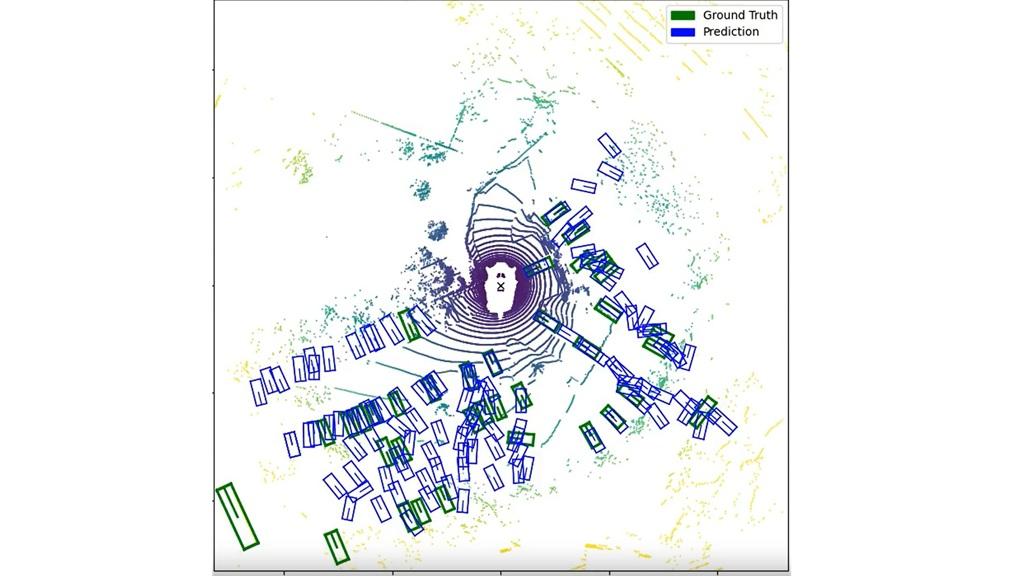
StreamPETR offers efficient 3D object detection for autonomous driving by propagating sparse object queries temporally.
streamPetr is an efficient multi-view 3D object detection model that introduces object-centric temporal modeling for streaming video input. Designed for autonomous driving scenarios, streamPetr propagates long-term historical information through object queries across frames, enabling online frame-by-frame 3D predictions while maintaining minimal storage and computational overhead. By utilizing TensorRT, streamPetr delivers fast, efficient inference tailored for real-time deployment in advanced autonomous driving systems.
This model is ready for commercial/non-commercial use.
This model is not owned or developed by NVIDIA. This model has been developed and built to a third-party's requirements for this application and use case; see link to Non-NVIDIA streamPetr Model Card
Governing Terms: The trial service is governed by the NVIDIA API Trial Terms of Service. Use of this model is governed by the NVIDIA Open Model License Agreement. ADDITIONAL INFORMATION: Apache 2.0 License.
Deployment Geography: Global
Researchers and developers in the field of autonomous driving and motion forecasting, specifically those working on end-to-end model development and deployment.
11/12/2025 via https://build.nvidia.com/nvidia/streampetr
References: GitHub Repository, arXiv Paper, Original streamPetr Repository
Architecture Type: CNN backbone + Sparse Query-Based Transformer
Network Architecture: streamPetr utilizes a standard image backbone (ResNet50 or Vision Transformer in varying configurations) to extract multi-view features from input camera images. These features are then processed by a Transformer-based detection head, which follows a sparse query design inherited from the PETR series. The architecture innovates with several modules:
Total Parameters: Undisclosed
Base Model: ResNet50/Vision Transformer
Input Types: Multi-view camera images, camera intrinsics and extrinsics, ego vehicle state
Input Formats: Python Dictionary/JSON
Input Parameters: 6x stacked Two-Dimensional (2D) RGB images (shape: 3 x 256 x 704), 6x 2D camera Intrinsic (4x4) matrix, 6x 2D camera Extrinsic (4x4) matrix, One-Dimensional (1D) ego vehicle state vector (Dimension 12)
Other Input Properties:
Input Context Length (ISL): 20 seconds scene duration
Output Types: Arrays of detected 3D bounding boxes, predicted 3D attributes for agents, bird's-eye view embedding tensor Output Format: Python Dictionary/JSON
Output Parameters:
Other Output Properties:
Output Context Length (OSL): Real-time frame-by-frame processing
Our AI models are designed and/or optimized to run on NVIDIA GPU-accelerated systems. By leveraging NVIDIA's hardware (e.g. GPU cores) and software frameworks (e.g., CUDA libraries), the model achieves faster training and inference times compared to CPU-only solutions.
Runtime Engines: TensorRT
Supported Hardware Microarchitecture Compatibility: NVIDIA CUDA & TensorRT compliant GPU
Operating Systems: Docker OS: Ubuntu 24.04.1 LTS (Noble Numbat)
The integration of foundation and fine-tuned models into AI systems requires additional testing using use-case-specific data to ensure safe and effective deployment. Following the V-model methodology, iterative testing and validation at both unit and system levels are essential to mitigate risks, meet technical and functional requirements, and ensure compliance with safety and ethical standards before deployment.
Model Name: streamPetr
Link: nuScenes dataset
Training Data Collection: Human
Training Labeling: Human
Training Properties: The nuScenes dataset (pronounced /nuːsiːnz/) is a public large-scale dataset for autonomous driving developed by the team at Motional (formerly nuTonomy). nuScenes dataset collects approximately 15h of driving data in Boston and Singapore. Driving routes are carefully chosen to capture challenging scenarios. nuScenes aims for a diverse set of locations, times and weather conditions. To balance the class frequency distribution, nuScenes includes more scenes with rare classes (such as bicycles). Using these criteria, data was manually selected to include 1000 scenes of 20s duration each. Link: nuScenes dataset
Data Modality: Vision (Multi-view Camera Images)
Training Data Size: ~15 hours of driving data, 1000 scenes of 20s duration each
Testing Data Collection: Human
Testing Labeling: Human
Testing Properties: nuScenes dataset was used for testing. Annotation partner Scale is used for annotation. All objects in the nuScenes dataset come with a semantic category, as well as a 3D bounding box and attributes for each frame they occur in. Ground truth labels for 23 object classes are provided.
Evaluation Benchmark Score: Undisclosed
Evaluation Data Collection: Human
Evaluation Labeling: Human
Evaluation Properties: nuScenes dataset was used for evaluation. These scenes are carefully annotated using human experts.
Acceleration Engine: TensorRT
Test Hardware:
NVIDIA believes Trustworthy AI is a shared responsibility and we have established policies and practices to enable development for a wide array of AI applications. When downloaded or used in accordance with our terms of service, developers should work with their internal model team to ensure this model meets requirements for the relevant industry and use case and addresses unforeseen product misuse.
Please report model quality, risk, security vulnerabilities or NVIDIA AI Concerns here